
Driveway Pothole Repair: What Lasts and When to Call a Pro
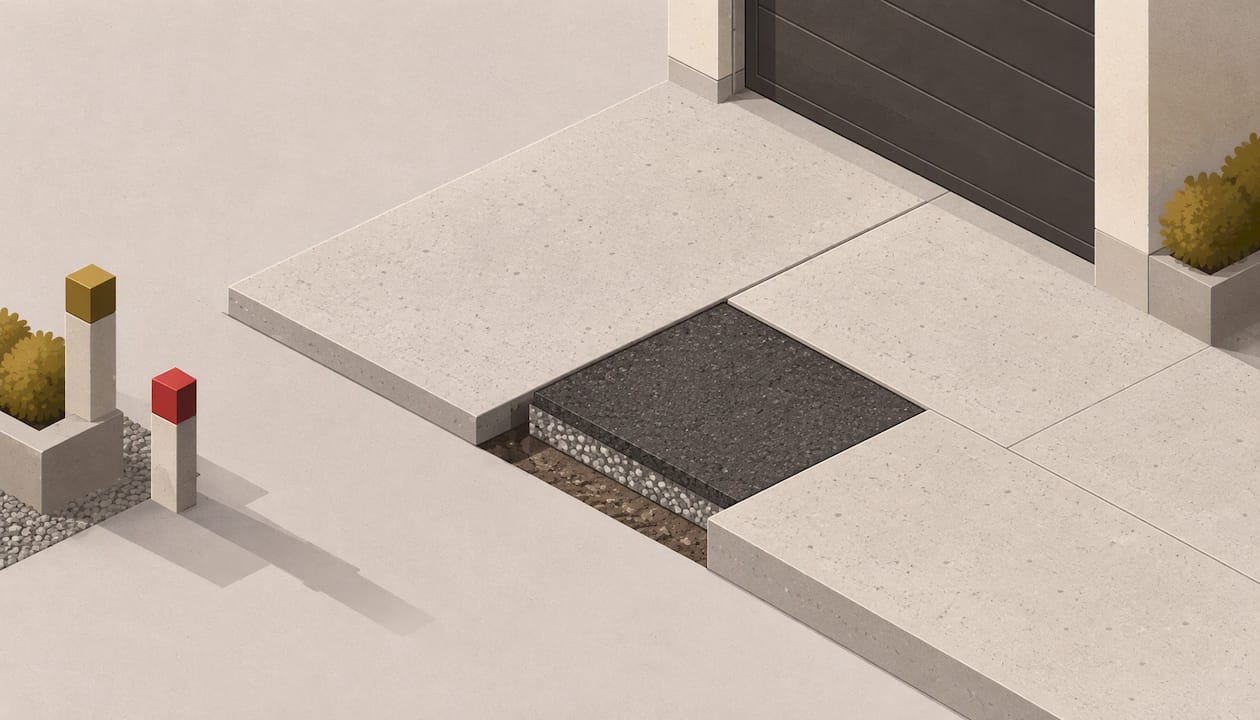
A driveway pothole is a small hole with a larger cause. Water gets under the surface, the base beneath it softens, frost and wheels do the rest, and the hole grows. A shallow, isolated pothole in a sound driveway can be filled with the right material. Several holes, a sunken area or a surface that keeps breaking up need the base put right, and that is a job for a contractor. Our driveways team works across Wiltshire and the surrounding areas and gives free written estimates.
This guide shows how to tell what your driveway is made of, how a proper repair goes, which materials suit which surface, and how to judge whether a patch will hold.
TL;DR
- Work out the surface first: tarmac (asphalt) and concrete need different repair materials, and the wrong one fails quickly.
- A lasting patch is cut back to firm edges, cleaned, dry, bonded and compacted in layers. Skipping any of these is why patches pop out.
- Cold-lay tarmac suits small tarmac holes. Concrete needs a repair mortar or resin product made for it.
- Several potholes, a sagging area or recurring water point to a failing base, not a surface problem.
- Send us photos for a free written estimate, and the repair is fully guaranteed.
Table of Contents
- Why driveway potholes form
- First, identify what your driveway is made of
- Assess the pothole before you touch it
- How a lasting tarmac pothole repair is done
- Choosing the repair material
- Concrete potholes: why patches shrink and crack
- How long does a patch last?
- Signs the job needs a professional
- Preventing potholes returning
- We do the repair, and the base underneath
- Get a written estimate for your driveway
- FAQ
- Sources
Why driveway potholes form
A tarmac or concrete surface is only the top layer. Under it sits a compacted stone base, and under that the ground. A pothole starts when water finds a crack, gets into the base and weakens it. Traffic then pushes the loose surface into the softened base. When the water freezes it expands, widens the crack and lifts more material out.
That sequence explains three things homeowners notice:
- Potholes appear after wet winters, because water and freeze-thaw cycles are the trigger.
- They show up where water sits: at low spots, beside downpipe outlets, at the foot of a slope or along edges.
- Filling the hole without stopping the water gets you the same hole again.
So before you look at materials, look at where the water goes. If a downpipe discharges onto the drive or the surface falls towards the middle, the repair needs to deal with that as well.
First, identify what your driveway is made of
The repair material has to match the surface.
Tarmac (asphalt or macadam). Black or dark grey, slightly flexible, with visible small stones in a black binder. It dents in hot weather and breaks at the edges as it ages. A pothole in tarmac has ragged, crumbly sides.
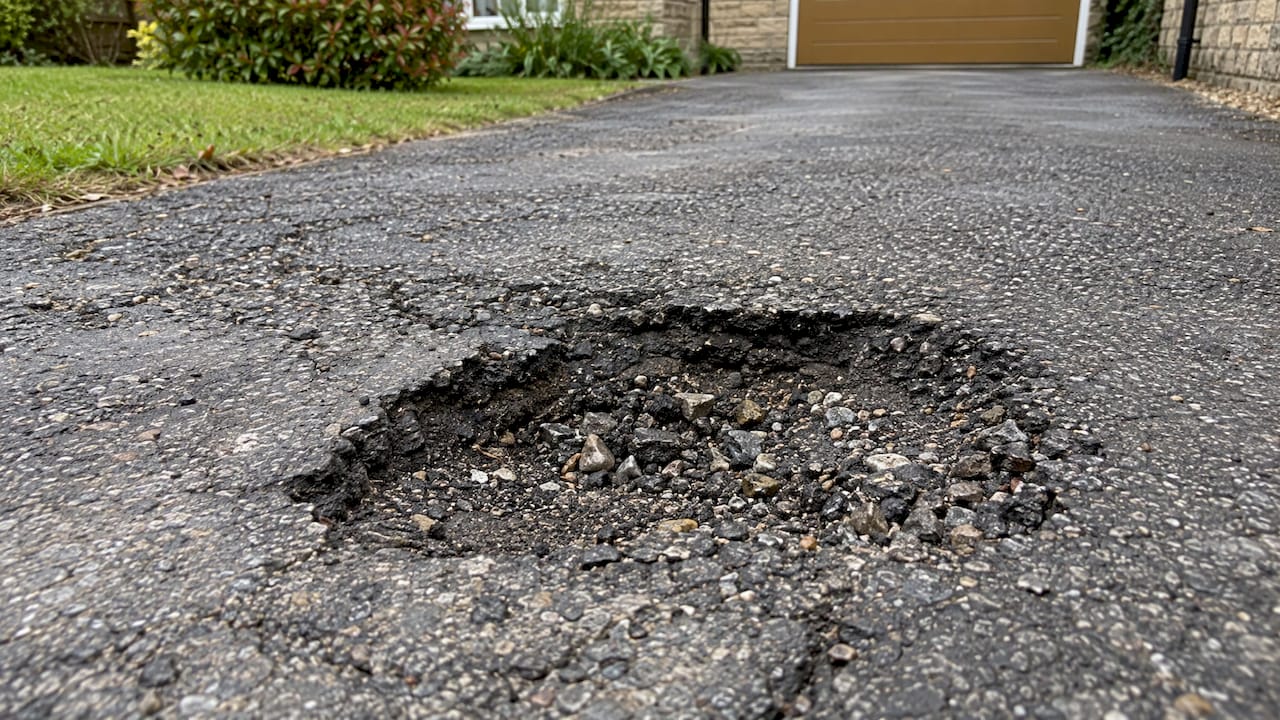
Concrete. Pale grey, hard, often with joints or saw cuts at intervals. A hole in concrete has hard, sharp edges and the surrounding surface may flake or scale.
Block paving, gravel or resin. These are not potholes in the usual sense. Sunken blocks or loose gravel are base or edging problems. Our guide to a sinking driveway covers what causes it and what the repair involves, and our resin driveway guide explains how resin surfaces are built on their bases.
If you are unsure, press a screwdriver tip into a clean edge. It marks tarmac and does not mark concrete.
Assess the pothole before you touch it
Measure three things.
- Depth. Shallow holes of a few centimeters sit in the surface layer. Deeper holes have reached the base.
- Spread. One hole is a local failure. A cluster, or a surface covered in fine cracks like crazy paving, means the whole area is wearing out.
- Surroundings. Press around the edge. If the surface is spongy or the edge crumbles away as you clear it, the weakness is bigger than the visible hole.
The result decides your route. An isolated hole with firm edges can be patched. A hole with soft surroundings, or a drive with several of them, is a case for professional resurfacing or reconstruction of the affected section.
How a lasting tarmac pothole repair is done
Cold-lay tarmac is a ready-mixed material that is used without heating, which is why it is the usual choice for small repairs. The method is the same whoever does it, and each step is where patches succeed or fail.
- Clear and dry the hole. Remove loose stones, mud and standing water. Material laid onto a wet, dirty base does not bond. Resincoat’s repair guidance for concrete sets a minimum ambient temperature of 5°C for application, and the same caution applies to any patching: do not repair in frost or heavy rain.
- Cut back to firm edges. Remove crumbling tarmac until the sides are solid and near vertical. A feathered, sloping edge breaks away under wheels. This is the step most DIY repairs skip, and it is the most common reason a patch fails within a season.
- Treat the sides and base. A bonding or tack coat helps the new material stick to the old. Without it, the patch can sit in the hole like a plug.
- Add material in layers and compact each one. Thick single pours leave voids and settle. Compaction is what gives the patch strength, and a hand tamper only goes so far on anything larger than a small hole.
- Finish slightly proud and seal the edge. Water must not be able to creep around the outside of the patch, so the edge is sealed or banded.
- Keep traffic off for the time the product requires. Follow the manufacturer’s guidance for the material in use.
If you want a second explanation of why preparing the hole matters so much, this guide to preparing the hole before filling covers how cold-lay material is laid in a prepared opening.
When the hole is deeper than the surface layer, the stone base underneath has to be rebuilt and compacted first, then the tarmac laid over it. That is where hand tools stop being enough, and where a contractor with a plate compactor gives a better result.
Choosing the repair material
The table shows the main product types and what the supplier says each does. Prices are the listed figures from the supplier pages and move with the supplier and VAT, so treat them as a guide to scale rather than a quote.
| Material | Suits | Supplier’s stated details |
|---|---|---|
| Cold-lay macadam | Small tarmac or asphalt repairs | £9.60 inc VAT per 25kg bag, no heating or mixing, covers about 0.4 m² at 30mm compacted thickness |
| Water-activated HAPAS-approved pothole repair | Tarmac and similar surfaces | £27.76 inc VAT per 25kg, covers up to 1 m² at 25mm deep, soaked before and after pouring and compacting |
| Three-part epoxy repair mortar | Concrete holes and deep cracks up to 50mm | £43.99 inc VAT for 10kg, needs 5°C or above, trafficable after 8 to 12 hours at 20°C |
| Rapid-cure MMA pothole kit | Permanent repairs, up to 300mm deep | £85.60 plus VAT, trafficable within 20 minutes, needs a primer on concrete |
HAPAS is a UK approval scheme that tests road and surfacing repair products, so an approved label is a sensible thing to look for on tarmac repair material.
Two practical points follow from the table. Bag coverage is small: a 25kg bag at 30mm depth fills less than half a square meter, so a hole of 60 cm across at that depth already uses most of a bag. And concrete is not repaired with tarmac. Concrete holes call for a repair mortar or resin product made to bond to concrete and to cure at least as hard as the slab around it, and the epoxy mortar’s maker states it cures harder than the surrounding concrete.
Do not use hot or self-mixed material. Heated bitumen and hot mixes cause serious burns and need rolling equipment to get the right density. Premixed cold-lay material exists so that small repairs avoid both.
Concrete potholes: why patches shrink and crack
Concrete patches fail for different reasons from tarmac ones. Ordinary cement mixes shrink as they cure and pull away from the old edge, leaving a hairline gap where water gets in. The remedy is a dedicated repair product, a clean, roughened and primed hole, and a patch that is not feathered to nothing at its edges.
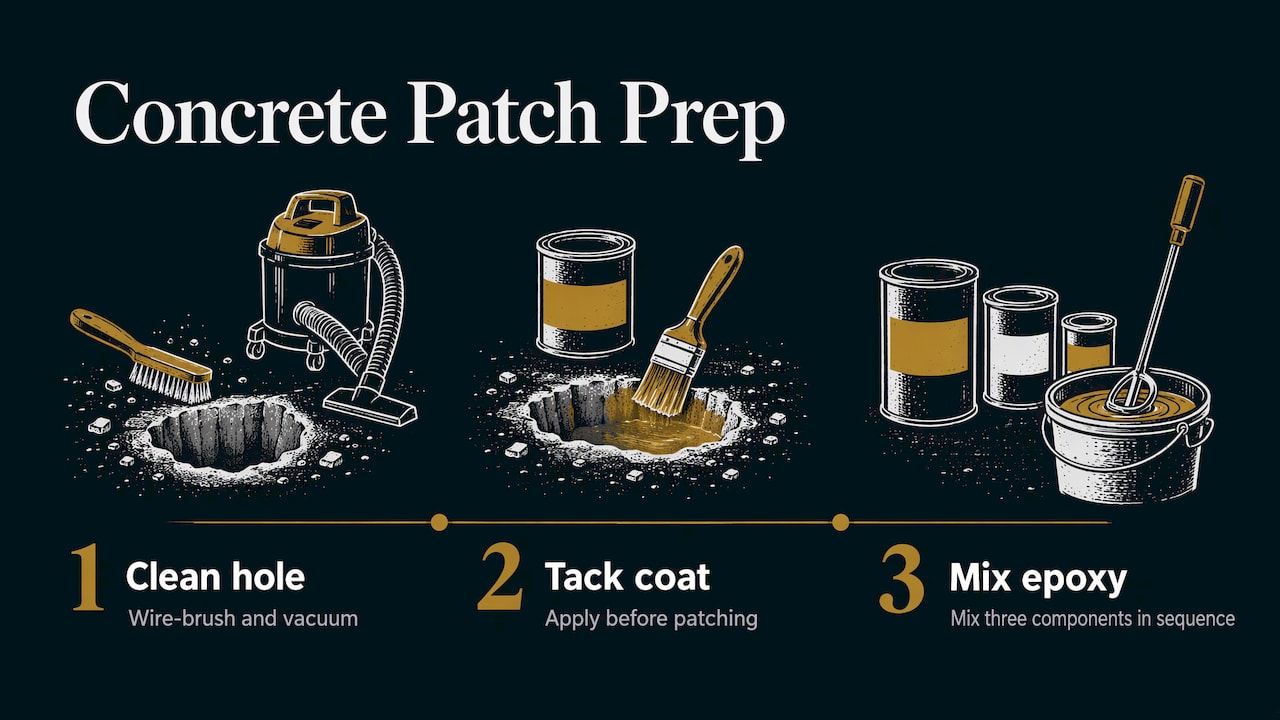
The epoxy mortar in the table calls for the hole to be wire-brushed and vacuumed, a tack coat applied, and three components mixed in sequence before use. The manufacturer’s directions are the ones to follow for any product. Where the slab is cracked right across, or has dropped on one side, a patch will not hold, because the slab itself is moving.
How long does a patch last?
There is no single answer, because lifespan depends on preparation, drainage and traffic. A patch cut square, bonded and compacted in a dry spell, on a drive whose water drains away, can last for years. A patch poured into a wet, unprepared hole beside a leaking downpipe may be gone by spring. Heavy vehicles such as delivery lorries, skips and vans shorten life, and so do tree roots near the surface.
The pattern to watch is recurrence. If a hole you filled reopens in the same place, the cause is below the patch, and more filler will not cure it.
Signs the job needs a professional
A small patch is a fair job for a careful owner on a sound drive. Call in a contractor when you see any of these:
- Three or more potholes, or new ones appearing each winter.
- A dip, sag or sunken strip, which suggests the base has moved. See our guide to driveway repair costs, fixes and when to call a pro.
- Crazing across the surface, where the whole top layer is breaking up.
- Water pooling on the drive after rain.
- A hole deeper than the surface layer, or one with soft, spongy edges.
- A drive that serves a business, where an unsafe surface is a trip and vehicle damage risk for visitors and staff.
For commercial property managers, the last point matters most. A pothole in a customer car park is a hazard you are responsible for managing, so a documented, guaranteed repair is worth more than a quick fill.
Preventing potholes returning
Prevention is mostly about keeping water out.
- Seal cracks early. A crack is the way in. Filling it with a suitable crack sealer before winter costs far less than the pothole it becomes.
- Sort the drainage. Make sure downpipes, gullies and channel drains carry water away from the surface, not onto it.
- Keep edges intact. Edges break first because they have no support. Check them each autumn.
- Clear vegetation. Roots and weeds in cracks lift the surface and hold moisture.
- Limit point loads. Park skips and heavy vehicles on boards, not on the edges of the drive.
- Look after the roof drainage too. Overflowing gutters that pour water onto the same patch of drive undo a good repair. Our fascias, soffits and guttering team can fix that side of the problem.
We do the repair, and the base underneath
A patch is only as good as the ground under it. That is why we look at the whole drive and not just the hole. Our driveways work covers block paving, tarmac and resin, and our groundwork services cover the preparation beneath. We offer free written estimates, so you know the scope before you commit, and our work is fully guaranteed.
Our view on driveway potholes
Most potholes we are asked about are not really about the hole. They are about water and the base beneath the surface. A neat patch on a failing base looks fine for a few weeks and then lets go, and the homeowner has paid twice.
That is why we think a repair should be judged on the preparation, not the filler. Cutting back to firm edges, dealing with where the water goes and compacting properly are what separate a repair from a cosmetic fix.
We also think the guarantee matters as much as the work. Fully guaranteed workmanship and a written estimate mean you know what is being done, who stands behind it and what it covers. For homeowners, that is peace of mind. For property managers, it is a record you can show.
If your drive has one hole with firm edges, you can treat it carefully. If it has several, or a dip, talk to us before the winter makes it worse.
Trey
Get a written estimate for your driveway
If your driveway has more than one pothole, a sunken area or a hole that keeps coming back, we will look at the whole surface and the base beneath it. Our driveway team covers Wiltshire and nearby areas, including Malmesbury and Swindon, and gives free written estimates with fully guaranteed work.

See our driveway services or go to our home page to get in touch. You can also look through our project gallery to see finished work.
FAQ
How do I fill a pothole in a concrete driveway?
Use a repair product made for concrete, not tarmac or a general cement mix. Brush and vacuum the hole until it is clean, apply the bonding coat the product specifies and follow the mixing directions exactly. One epoxy mortar’s maker states it works in holes up to 50mm deep and needs at least 5°C. Deeper or spreading damage should be assessed by a contractor.
What is the best material to fill a driveway pothole?
It depends on the surface. For tarmac, a ready-mixed cold-lay material, ideally HAPAS approved, is the usual choice for small repairs. For concrete, use an epoxy or similar repair mortar. For deeper holes the base must be rebuilt first, so the best material is only part of the answer.
How much does it cost to repair one pothole?
Materials for a small hole are modest: one supplier lists a 25kg bag of cold-lay macadam at £9.60 including VAT. Professional repair prices depend on depth, access and how much of the base needs work, so we give a free written estimate after looking at the drive.
Can I repair a pothole in winter?
It is best done in dry, settled weather. Repair products set a minimum temperature, often around 5°C, and wet or frozen holes do not bond properly. If a hole is a hazard in the meantime, mark it and keep vehicles off it until conditions allow a proper repair.
When should I replace the driveway instead of patching it?
Consider it when potholes keep appearing, the surface is crazed across, or the drive has sunk or drains poorly. At that point, patching is repeated spending on a failing surface, and resurfacing or rebuilding the base is the longer-lasting answer.
Sources
- Resincoat Deep Fill Epoxy Repair Mortar
- Patchphalt Cold-Lay Macadam 25kg
- Viafix 10mm Pothole Repair
- Degafill Permanent Pothole Repair Kit