Roofers in Chester: How to Choose One You Can Trust
The best roofer in Chester is one you can verify, who quotes in writing, whose work is guaranteed in writing and who will still be reachable when something goes wrong. Chester has plenty of roofing firms, so the real task is separating the dependable ones from the traders who vanish after the deposit. We cover Chester from our Wiltshire base, and our roofing work is fully guaranteed with free written estimates. This guide gives you the checks, the cost factors and the paperwork that apply whether you hire us or anyone else.
TL;DR
- Check membership claims in the trade body’s own directory, then match the company name, address and phone number exactly.
- Get at least three itemised written quotes that use the same scope and materials, and do not choose on price alone.
- Leaks do not always mean a new roof: local repairs can be enough if the rest of the roof is sound.
- Stay off the roof yourself. In an emergency, keep people clear, photograph the damage and call a professional.
- Ask for guarantees, certificates and warranties in writing before you pay the final invoice.
Table of Contents
- What a Chester roofer should be able to do
- How to check a roofer before you let them near your house
- What roof work costs, and what moves the price
- Getting quotes you can actually compare
- Guarantees and insurance
- A leak, a missing tile or storm damage
- Planning permission and Building Regulations
- Extensions, lofts and the roof above them
- Commercial property: maintenance beats emergency repair
- Working with Yellowstone in Chester
- Our view on choosing a roofer
- FAQ
- Sources
What a Chester roofer should be able to do
A homeowner with a slipped tile and a property manager with a leaking flat roof over a shop unit need different things, but the work usually falls into a few groups:
- Pitched roofs: repairs, re-tiling and complete new roofs. See our new roofs page.
- Flat roofs: we fit EPDM, GRP and torch-on felt systems, which suit extensions, garages and many commercial buildings. See flat roofs.
- Chimneys: repair and rebuilding, which often goes hand in hand with roof work. See chimneys.
- Roofline: fascias, soffits and guttering, the parts that carry water away from the walls. See fascias, soffits and guttering.
- Larger projects: home extensions, loft conversions and insulation, and conservatories, where the roof is part of a bigger build.
One firm handling the roof, the roofline and the chimney means one contract, one point of contact and one guarantee. That is easier to manage than three tradespeople arriving on different days.
How to check a roofer before you let them near your house
This is the step that separates a good job from a bad one. Work through it in order.
1. Find the company, not just the advert
The Cheshire West and Chester Council Trading Standards team, in a warning published on 16 November 2023, names a trader who communicates only through social media or messaging apps as a red flag, because such a person can be hard to trace if they disappear. You want a business with a real name, a postal address and a landline or office number you can call back.
2. Verify any trade membership yourself
The National Federation of Roofing Contractors (NFRC) is the UK trade body for roofing firms. Its scam warning of 12 October 2026 says to confirm membership in the NFRC’s own directory and to match the company name, address and contact details exactly. It adds that third-party listings and unverified claims can mislead. A logo on a van or a website proves nothing on its own.
The NFRC also says its members pass an inspection before joining and are inspected every three years for technical competence and commercial capability.
3. Go through the Trading Standards checklist
The council’s checklist covers six things: qualifications or scheme registration, valid insurance, details of any subcontractors, examples of similar completed work, company information, and written quotes and contracts. Ask for each. A reputable firm will not mind.
4. Watch for pressure and odd payment demands
The same council warning cautions against high-pressure selling and against staged payments that do not match the work actually completed. A sensible payment plan follows progress on site, not the contractor’s cash needs.
5. Look at similar jobs
Ask to see recent work comparable to yours, such as a chimney rebuild or a flat roof on an extension. Photographs of finished projects help, and our gallery shows examples of our roofing and property work.
What roof work costs, and what moves the price
Anyone who quotes a fixed price over the phone without seeing the roof is guessing. The Federation of Master Builders (FMB) says in its roofing guide that a new roof can cost from about £4,500. It lists the factors that shape the final figure:
- roof size and pitch
- height and complexity
- access to the roof
- materials chosen
- the condition of the structure underneath
A bungalow with a simple pitch and a three-storey terrace with a hip roof and a chimney stack are different jobs, even if the floor area looks similar. Scaffolding is often a major line in the quote. Some repairs need only a ladder, and others need full access.
A callout for a small repair is a different matter from a replacement. We do not publish prices, because a fair figure depends on what the roof needs. We give free written estimates, so you see the cost for your own roof in writing rather than a headline number.
Getting quotes you can actually compare
The FMB recommends at least three itemised quotes using the same scope, materials and assumptions. The NFRC likewise advises choosing up to three contractors, comparing their advice and your confidence in them, and not simply picking the cheapest.
A useful quote states:
| What to look for | Why it matters |
|---|---|
| Scope of work | Shows exactly what is being repaired or replaced |
| Materials | Lets you compare like with like |
| Price and VAT | Stops a surprise addition later |
| Scaffolding and waste removal | Often left out of low quotes, so check they are included |
| Payment stages | Should follow completed work |
| Hidden defects | Agree how rotten timber or other surprises will be priced and approved |
| Approvals | Who deals with any planning or building control paperwork |
The FMB’s advice to agree in advance how hidden defects will be priced is worth following. Once the old tiles are off, a roofer can find rotten battens or rafters, and a clear process stops that turning into an argument.
Guarantees and insurance
A guarantee is only as good as the business behind it. The NFRC recommends asking for a guarantee on new or refurbishment work, and says an insurance-backed guarantee gives independent protection if the contractor goes out of business. Ask what the guarantee covers, how long it lasts and what you need to do to keep it valid.
At handover, collect the certificates and warranties. The FMB guide recommends this, and you will want them when you sell the property or make an insurance claim. Our work is fully guaranteed, and we back it with extensive warranties.
A leak, a missing tile or storm damage
If water is coming in, the order matters.
- Keep people away from damaged areas. Do not touch wet electrical fittings.
- Do not climb onto the roof. The FMB guide warns householders against it, and the Health and Safety Executive says roof work is dangerous even when brief and that roofs should be treated as fragile until confirmed otherwise.
- Look from the ground. The FMB suggests viewing the roof from the ground, and checking the loft only if it is safe to do so.
- Photograph everything. The Institution of Structural Engineers advises documenting damage and notifying your insurer promptly. Keep receipts and invoices for urgent temporary repairs.
- Call a roofer for temporary weatherproofing. The FMB says a roofer can make the area watertight before permanent repairs are agreed. We run an emergency repair service for exactly this.
In immediate danger, call the emergency services. For structural worries such as a partly collapsed roof, the Institution of Structural Engineers says to contact the local authority Building Control team. For a clear walk-through of the first hours after a storm, these storm damage first steps cover the basics of staying safe and recording damage.
A leak does not automatically mean a new roof. The FMB says local repairs may be enough where the surrounding roof is sound. A good roofer will tell you which it is. Our roof repairs page explains how we deal with leaks and tiles, and our guide to residential roof repair lists the signs to look for.
Planning permission and Building Regulations
Two separate systems can apply, and your roofer should know both.
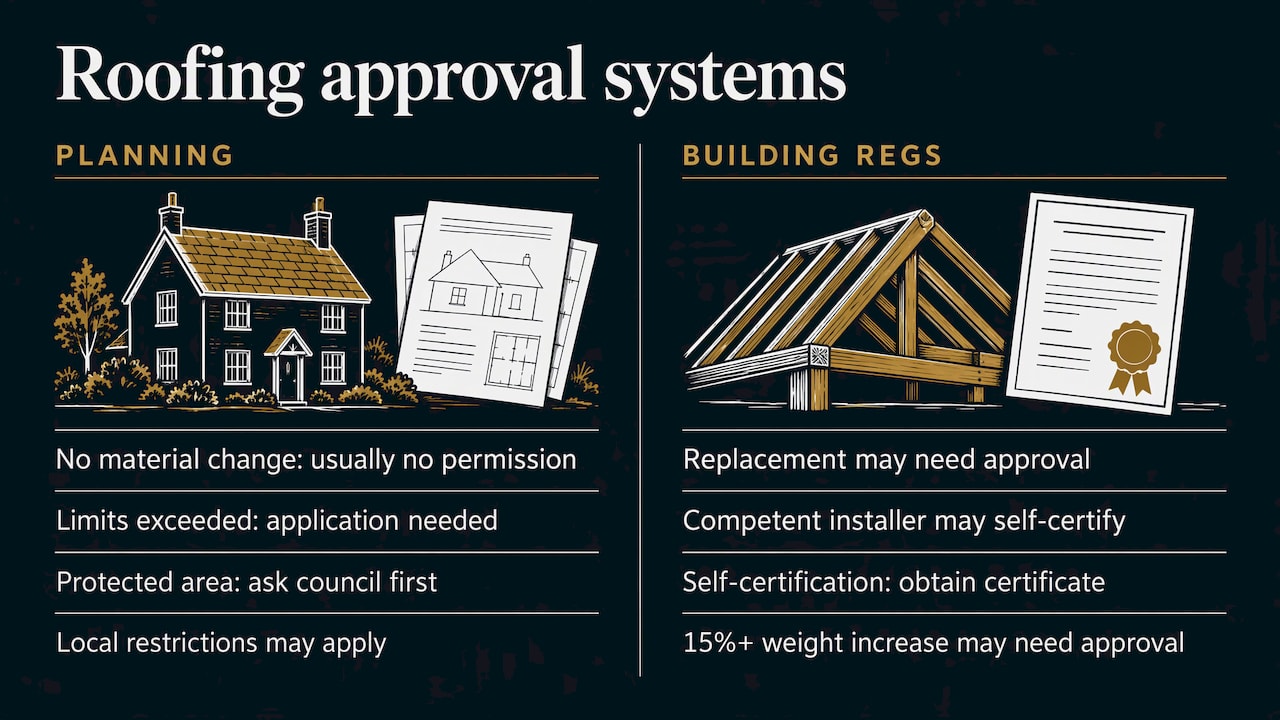
Planning permission. The Planning Portal says re-roofing that does not materially affect the external appearance of a house will usually not need planning permission, but permitted-development limits and local restrictions apply. Alterations outside those limits, or where permitted-development rights have been removed, need an application. If your home is in a protected area, ask the council before you order materials.
Building Regulations. GOV.UK says a replacement roof may need Building Regulations notification and approval, unless a competent-person installer self-certifies the work. If they do, you should obtain the compliance certificate. The Planning Portal’s guidance on existing roofs adds that approval may be needed when work exceeds stated area limits, involves structural alterations, significantly changes fire performance or increases the weight of the covering by 15% or more.
These rules are for England. Newport and Cardiff, where we also work, fall under Welsh rules, so the same questions should be put to the local council there.
Extensions, lofts and the roof above them
If you are planning an extension, the roof shapes the whole design. The FMB notes that a flat or low-slope roof often suits a single-storey extension, while a pitched roof matching the existing style may blend better and last longer. Planning permission and Building Regulations are checked separately.
For lofts, the Planning Portal says a conversion can be permitted development only if its conditions are met. The stated volume limits are 40 cubic metres for terraced houses and 50 cubic metres for other houses. Beyond that, planning permission may be required.
We handle extensions, lofts and conservatories alongside the roofing, which means the roof, the structure and the insulation are planned by the same team.
Commercial property: maintenance beats emergency repair
For a property manager, the cost of a roof failure is more than the repair: it is the disruption, the tenant complaints and the interior damage. HSE guidance says all roof work must be planned and organised safely, and that those doing it must be competent, trained and instructed in the precautions required. Ask any contractor for their method statement for your building, covering access, edge protection and fall precautions.
Planned maintenance, with gutters cleared, flat roof surfaces checked and fixings inspected, lets problems be found early. We carry out roofing maintenance for commercial clients as well as homeowners.
Working with Yellowstone in Chester
We are Yellowstone Roofing and Property Contractors, and Chester is among the areas we cover. You get a free written estimate, thorough project management from first visit to handover and skilled craftsmanship backed by a fully guaranteed result. We have glowing references from past clients, and our Google listing shows 5★ from 39 reviews.
Tell us what you need, whether it is a repair, a new roof, a chimney, a flat roof or an extension, and we will put the answer in writing. Start on our website or look at the new roofs page.

Our view on choosing a roofer
Most roofing problems we are asked to put right began as a decision made on price alone, or a handshake with no paperwork behind it.
Our advice is the same for a small repair and a full new roof. Get the scope in writing. Know who is doing the work and who is responsible if it fails. Keep the guarantee and the certificates somewhere safe.
That is why we give free written estimates, manage each project from start to finish and stand behind our work with extensive warranties. A roof should be something you stop thinking about, and that comes from careful craftsmanship and clear agreements.
Trey
FAQ
How do I spot a dodgy roofer?
Warning signs include a trader who only uses social media or messaging, who pressures you to decide quickly, or who asks for payments that do not follow the work done. Check any trade membership in the body’s own directory and match name, address and phone number exactly. Ask for insurance details, subcontractor information and a written quote.
How many quotes should I get?
The FMB recommends at least three itemised quotes using the same scope, materials and assumptions. Compare what is included, such as scaffolding, waste removal and VAT, as well as the total. The cheapest figure is not automatically the best value.
Do I need a new roof if it leaks?
Not always. The FMB says local repairs may be enough if the surrounding roof is still sound. A roofer who inspects properly should explain whether you need a repair or a replacement and put the reasoning in writing.
Can I check the roof myself?
Look from the ground, and check the loft only if it is safe. Do not climb onto the roof: the HSE says roof work is dangerous even when brief and roofs should be treated as fragile. Photograph anything you see and send the pictures to your roofer and insurer.
Does a new roof need Building Regulations approval?
It may. GOV.UK says a replacement roof can need notification and approval unless a competent-person installer self-certifies it. Ask your roofer which route applies and make sure you receive the compliance certificate.
Sources
- Council Trading Standards officers warn of cowboy builders using social media platforms
- NFRC: Choosing a roofing contractor, homeowners
- NFRC: Combat the rise in roofing scams by checking before you hire
- FMB: The ultimate guide to roofing
- HSE: Roof work
- Institution of Structural Engineers: Dealing with storm damage
- GOV.UK: Building work, replacements and repairs to your home
- Planning Portal: Roof planning permission
- Planning Portal: Building Regulations for work to an existing roof
- Planning Portal: Loft conversion planning permission
- Storm damage and your roof: what to do first